
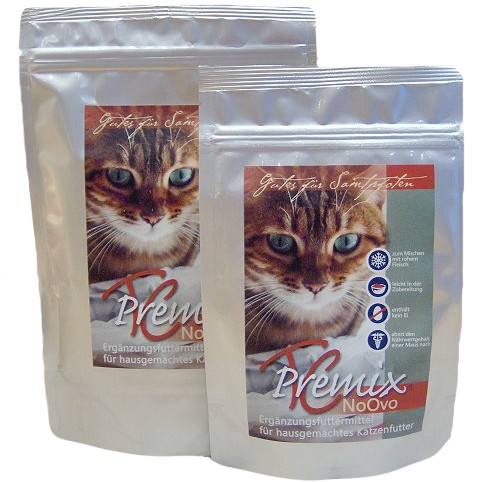
TCPremixNoOvo, 540 g

Prices incl. VAT plus shipping
Item in stock
Delivery time appr. 5-7 business days
- Order number: 0389022
-
- Raw feeding premix for cats
- Quick and easy to prepare
- Made in Germany
- One pouch makes approx. 11 kg
of finished cat food
- Reflects the nutritional composition
of a mouse
Cat Food as Nature Intended
TCPremixNoOvo is a carefully formulated source of essential nutrients that are lacking in fresh, raw, boneless meat. The premix provides important minerals, trace elements, amino acids and vitamins, as well as taurine, which is essential for cats. Including psyllium husk - a natural source of dietary fibre.
Preparing fresh meals with TCPremixNoOvo is easy. Following our recipe, your homemade cat food mimics the nutritional composition of a mouse and is suitable as a balanced daily diet for healthy cats of all ages.
Natural. Complete. Made with care since 2007.
Egg yolk has been omitted from this formula, making it suitable for cats with a sensitivity to egg or poultry. Alternatively, this premix gives you the option of adding fresh egg yolk to the cat food during preparation.
Ingredients
Whole Bone Extract, Gelatin, Whey Protein, Calcium Carbonat, Seaweed Powder.
Additives per 1 kg: Taurine, Vitamin-B-Complex (Vitamin B1, Vitamin B2, Niacinamide, Pantotenic acid,
Vitamin B6, Vitamin B12, Biotin, Folic acid, Choline), Vitamin E, Vitamin D3 (2777 IU).
Typical Analysis
Protein ...........59,5%
Fat...................<1,0%
Fibre ...............<0,3%
Ash..................33,5%
Moisture.......... 6,1%
Manufactured in Germany by Tatzenladen
Recipe for 1 kg of Meat: 900 g Meat + 100 g Liver
1. Measure 40 g TCPremixNoOvo® into a bowl.
2. Add 190ml of water and combine thoroughly.
3. Add 900 g raw meat of your choice and 100 g raw liver, mix thoroughly.
4. Divide into daily servings of 130–175 g per adult cat, either freeze and thaw before
feeding or serve fresh.
Adjust portion sizes according to your cat’s age, activity, and needs.
This recipe prepares 1,230 g of finished cat food.
Good to Know:
• Always follow the recipe.
• Adding liver is essential; it is not optional.
• If you cannot source fresh liver, you can use 25 g of our organic poultry liver powder per
900 g of meat.
• Do not use bones (whole chickens, wings, drumsticks, necks, etc.) with this recipe.
• Feel free to supplement the finished cat food with oils, extra fat (for lean meats), or
vegetables.
Enjoy making your homemade cat food!
How to Store TCPremix
TCPremix contains no preservatives, so it’s naturally best when used fresh. We make only small batches to ensure it arrives at your home at peak quality. To keep it that way, proper storage at home is important – a cool, dry place will help maintain its freshness and nutritional value.
Storing opened packs
Once opened, TCPremix should be stored in a dry place and kept as airtight as possible. This helps preserve the quality of the powder. After each use, carefully reseal the pouch and squeeze out as much air as possible. If you prefer, you can also transfer the premix to a clean, dry, well-sealed storage container.
A cool, dry place protected from moisture is ideal for storage. If you plan to keep an opened pack for a longer period, it can also be stored in the freezer, where the premix is especially well protected from moisture. Even when stored in the freezer, the premix should be used before the best-before date.
If you choose to store TCPremix in the refrigerator, please make sure the pouch or storage container is always tightly sealed. Changes in temperature can cause condensation to form, which may affect the quality of the premix.
Buy Only What You Need
We recommend purchasing only as much TCPremix as you expect to use before the best-before date when stored correctly. This helps ensure that your premix is always as fresh as possible.
Handle with care
Always use clean, dry utensils when measuring out the premix, and only remove the amount you need to prepare your cat's food. Afterwards, squeeze as much air as possible out of the pouch and reseal it carefully. Especially during warm weather, these simple steps help keep your premix fresh and maintain its quality for as long as possible.
At a Glance
- Store the premix in a dry place and keep it as airtight as possible.
- Alternatively, transfer it to a clean, dry, well-sealed storage container.
- Protect from heat and direct sunlight.
- For longer-term storage, opened packs can also be kept in the freezer.
- Even when stored in the freezer, use the premix before the best-before date.
- Buy only the amount you can use before the best-before date.
Serving sizes for adult cats
Any recommendations on serving sizes we can make can only be a good guess - a starting point to use in your play with your cat’s portion sizes and mealtime frequency. Determining your cat’s ideal daily portion size is unfortunately not as easy as a chart which tells you: if your cat weighs this much, feed her that amount. Cats are individuals. Some are big, but thin. Others are small, but fat. They are young and old, male and female, active or sedate, and more. Some have fast metabolism and others don’t. Any chance of providing you with a simple chart is made more difficult by the fact, that a homemade diet will turn out differently with the meat you use and with how precisely you follow instructions. Some customers use lean poultry, other use fatty beef. A fatty beef diet will be more filling and calorie dense than the same volume of a lean turkey diet. Some customers add more water, giving the food more volume but not more calories, while others omit water and wonder why their cats gain weight on so little food.
Caregivers are often distressed about their cat’s behavior of finishing their plate in less than a minute, asking for more food, pestering them at the fridge, or taking food stuff off counters or out of the trash, prompting them to think that their cat is starving or lacking something! Some cats don’t do this, but most will not miss an opportunity to eat. It is natural for an animal to be opportunistic, and this is part of their instinct to survive. However, much of this is conditioning: how your cat was raised and how your cat has trained you!
Food requirement should be based entirely on body condition, and not on behavior. If your cat suddenly looses weight without changes in the diet, consult with your Veterinarian about possible illness or internal parasites.
It is especially difficult to monitor food intake and its effects on a cat allowed outdoors. Outdoors, your cat can regurgitate food without you knowing, and all you notice is that he or she is loosing weight. The eating of mice and other prey will add calories, but also predispose your cat to intestinal parasites. Outdoor, cats will often travel long distances, which takes extra calories. Outdoor, cats may scavenge food from neighbors, which puts them at a great risk not only from weight gain.
Our suggestions are to feed a daily portion of 130 g – 175 g as two or three meals every day
Unless you have a very large cat, like a young, active, outdoor, male Main Coon cat, or a crazy Siamese, 99% of cats will fall into this portion range. Some older, more sedate cats will actually gain weight on that amount of food a day.
Cats are individuals. Some will maintain a level of excitement about food throughout their live. Others are largely uninterested in eating, and need coaxing to eat even as kittens. Most cats do well eating three meals every day, but some are not interested in eating more often than twice every day; sometimes they only show enthusiasm for one meal per day. Other cats will eat anything, any time, for no reason. Cats’ personality and emotional state is very much expressed by how they eat!
Cats of the genus Felis, including the domestic cat, are adapted to prey on rodents, small birds, and the occasional reptile and amphibian as the main staple of their natural diet. A single mouse weighs no more than 30 gram, providing approximately 60 kcal. In order to meet their daily caloric requirement, cats must eat an average of five prey animals every day. This amount of food is not consumed all as one meal, but as separate meals throughout the day as the cats succeed in catching that prey. Field observations have concluded that most small cat species are adapted to and prefer to be active during dusk and dawn - the time when they will hunt most of their prey - resulting in an intake of several smaller “meals” during these hours. Naturally, cats will rest, groom, doze, or sleep during daytime hours.
While we can draw some practical insight from the natural model, feeding five meals of 30 gram each to our cats during the morning and evening hours is hardly a possible solution for most of us. Our personal experience has been that cats do very well eating two meals every day of 50 g – 70 g each.
Weighing your cat's serving is a good tool, because we have a natural tendency to over-feed
Regurgitation of food can be almost entirely abolished by feeding meal sizes not exceeding 35 g, and to feed the daily requirement as 3-4 meals. Young, large, active cats who require more than 140 g of food every day should be given an extra meal rather than increasing the size of their meal.
The stomach of a cat is about the size of a walnut when empty. It can stretch, but trying to fit a 115 g of food into it as one meal, is “over-stretching” it a bit. Saliva and digestive juices will add additional volume. A cat will not always select instinctively what he or she needs and how much.
Cats are individuals. While we can give you guidelines, none of our suggestions will work for everyone. Cats are a joy and a challenge all in one. They are a challenge especially when feeding them. So specialized in what they would naturally eat. One thing is certain, though: if you invite a carnivore into your life that eats meat, it is not going to be cheap
With TCPremix you have the choice and control over the primary ingredient in your cat’s food: the meat.
During our studies and research we have tried nearly all possible sources of meat for our cats’ food, and the following list demonstrates how creative you can get, depending on your resources and preferences. Muscle and organ meats are the most essential foods for your cat, and special care should be applied when selecting them.
Meats must be raw, fresh and human-grade. Feed a variety of meats to your cat. This provides stimulation. Prevents fixation and guarantees a well balanced meal plan with little room for deficiencies.
• Chicken & Turkey - breast, fillet or thigh, heart
• Rabbit - stewing meat, boneless loins, neck, shoulder
• Venison - stewing meat, neck, shank, shoulder
• Lamb - boneless stewing meat, shank, leg or butt
• Beef - stewing meat, heart, boneless steak or roast
To make cat food, grind meats or cut into small chunks.
Please feel encouraged to try more meat varieties.
When using TCPremix, if possible, choose liver from the same type of animal as the meat used in preparing your cat’s food. However, if you cannot match up meat and liver, please don’t omit the liver altogether. Liver is an essential part of your cat’s diet. Instead, prepare your cat’s food with miss-matched meat and liver.
Can I use meat with bone with TCPremix?
Please do not use bones or meat with bone (like whole ground chicken, thighs with bone, backs, and or wings; or whole ground rabbit) when preparing cat food with the TCPremix premix. All our formulas already contain all the essential minerals, which would otherwise be supplied to the cat from her prey’s bones. Preparing our raw diet premix with meat that contains bone can cause constipation and unbalance the finished cat food.
Which Fibre Sources Work Well?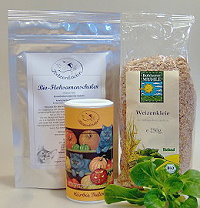
Many cat owners ask which types of fiber are best for homemade cat food and how much to use. To help, we’ve put together tried-and-true options that work well in everyday feeding and are gentle even on sensitive cats.
Fibre has a positive effect on the water content and bulk of the stool and helps regulate the passage of food through the digestive tract. With a natural, fresh-meat-based diet, the stool of raw-fed cats is naturally firmer than that of cats eating commercial catfood. For many cat owners, this can be a little concerning, as they worry their cat may have to strain or even experience discomfort when going to the litter box.
When changing your cat’s diet, the body needs time to adjust to the new food. The digestive system and enzyme activity gradually adapt to fresh food. Especially when switching from commercial kibble to fresh meat, it’s a good idea to include some fibre in the meals to help prevent stool problems and keep digestion running smoothly. Some cats manage perfectly well with just a tiny amount of added fibre. Every cat is unique, so it’s a good idea to experiment and see how much fibre your little friend needs to support healthy digestion.
Suitable Fibre Sources
There are several plant-based fiber sources that work well, and help support healthy digestion in cats:
• Steamed and pureed carrots
• Steamed and pureed zucchini
• Steamed and pureed Hokkaido pumpkin
• Finely chopped salad greens, such as lettuce or lamb’s lettuce
• Finely chopped cat grass
• Psyllium husks
• Wheat germ
• Flaxseeds (must be cooked in water beforehand)
• Sunflower seeds
• Shredded coconut
Vegetable Amounts in Homemade Cat Food
The plant-based portion in homemade cat food should make up about 3-5% of the total meal. That means for 1 kg of meat, you would add roughly 30-50 g of vegetables.
If your cat has specific health needs or preferences, you can adjust this amount accordingly. For sensitive cats, it’s a good idea to lightly steam and puree the vegetables to prevent digestive issues. Some cats tolerate raw vegetables, like grated carrots, very well, while others may be a bit more sensitive. Experiment to see what works best for your furry friend.
Signs of Healthy Digestion and Stool
A healthy cat’s stool should be well-formed and easy to pass, with little to no odor in the litter box. Ideally, your cat should go every day or every other day without straining.
Important: If your cat struggles significantly to pass stool, it’s important to have them checked by a veterinarian or animal health professional.
Adding fat to a lean meat diet
A look at the natural diet of the cat provides the answer: a prey animal is not only muscle meat, but also fat tissue, skin, and other energy-rich parts. Cats naturally eat these as well, and they play an important role in meeting their energy needs.
When a raw meat diet is mainly based on lean muscle meat, the natural fat content is often too low. The diet may still provide enough protein, but it may not always cover the cat’s full energy requirements.
How to add fat when feeding lean meat
If the diet is mainly based on lean meat, it can be helpful to add fat to keep it balanced. Suitable sources include fatty trimmings from the same type of meat, poultry skin, or other animal-based fat sources. Other options include fattier cuts such as beef, lamb, or duck, as well as beef or lamb fat, or goose or duck fat without additives. These help increase the overall fat content of the diet in a natural way.
If suitable animal fat sources are not available, a small amount of butter can be used. It provides energy and is usually well tolerated in small amounts. For long-term feeding, however, animal-based fat sources such as trimmings, skin, or rendered fats are the better choice, as they are closer to the cat’s natural diet. It is best to introduce fat gradually so the digestive system can adjust. Not every cat tolerates higher fat levels in the same way. The right amount of fat depends on several factors, including the fat content of the meat, the cat’s energy requirements, activity level, and body condition. Some cats need more fat, while others do well with less.
Fat is more than just a source of energy. It is a natural part of prey, helps create a balanced, species-appropriate diet, and is also important for palatability, making meals more appealing to cats.
Fat is not the same as oil
A common misunderstanding: fat and oil are not the same and play different roles in nutrition.
Animal fat is an important part of a balanced raw meat diet. It mainly provides energy, supports the absorption of fat-soluble vitamins, and reflects the natural composition of prey animals. If fat is missing in a diet based on lean meat, it should be supplemented with suitable animal fat sources.
Oils, on the other hand, are not used as an energy source but may provide specific fatty acids depending on the type of oil. They do not replace dietary fat.
Animal fat provides energy and is part of a natural diet, while oils support specific fatty acids but do not replace fat.
Both can have a place in a balanced diet, but they serve different roles.
Tatzenladen
Inh. Nicole Kipp-Meilwes
Bärenshöfter Straße 16, 24980 Schafflund, Deutschland
E-mail: info(at)tatzenladen.de


